How to Receive SMS OTPs Abroad Without Paying Roaming Fees
Learn how digital nomads and expats use virtual numbers to receive 2FA codes and SMS OTPs from US and UK banks while traveling.
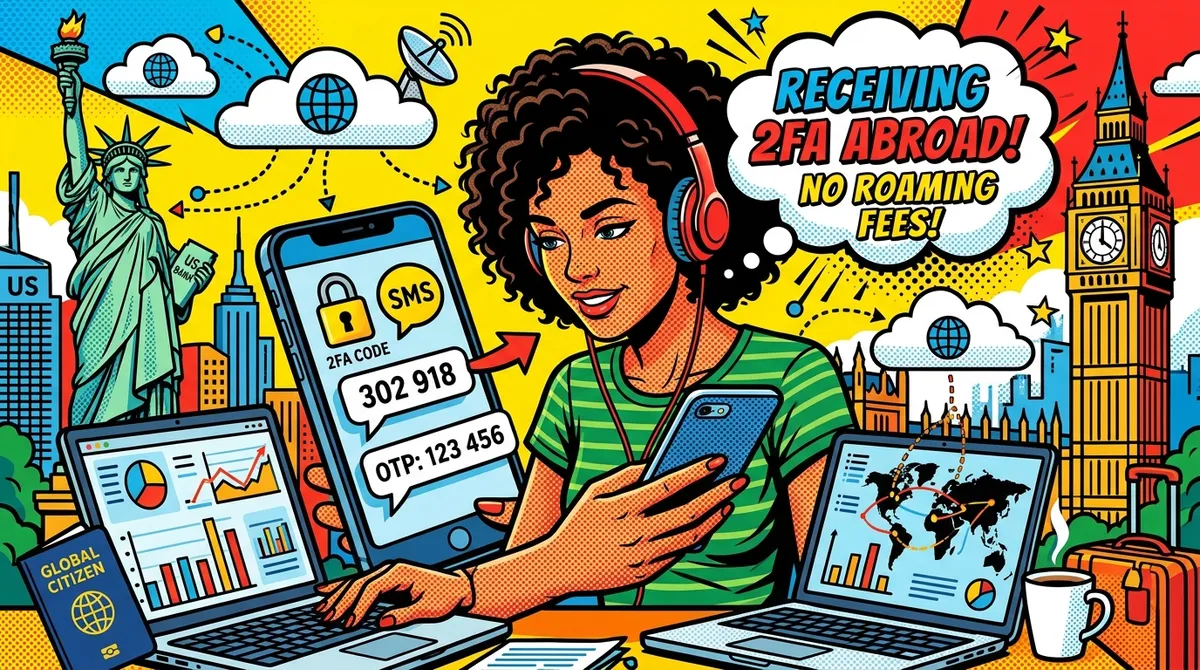
How to Receive SMS OTPs Abroad Without Paying Roaming Fees
You’re sitting in a café in Lisbon, trying to log into your US bank account. The login page asks for an SMS verification code. It sends it to your American number — the SIM card sitting in a drawer back home. You’re locked out.
This is one of the most common, most frustrating friction points for digital nomads and expats. Here’s how to fix it permanently.
The Real Cost of Relying on Roaming
International roaming fees are not just expensive — they’re unpredictable. Depending on your carrier and the country you’re in, receiving a single SMS can cost anywhere from $0.50 to over $2.00. Making a short call to your bank’s verification line can rack up charges fast.
But the bigger problem isn’t the cost. It’s the reliability gap.
- Your home SIM may be deactivated if you’ve been abroad too long
- Roaming coverage drops out in many countries entirely
- Carrier-level blocks sometimes prevent international SMS delivery
- Prepaid plans often suspend service after 60–90 days of inactivity
For anyone living or working outside their home country for months at a time, roaming is simply not a viable long-term strategy.
What Actually Happens When You Miss an OTP
Two-factor authentication (2FA) via SMS is now standard across banking, government portals, brokerage accounts, and major platforms like PayPal and Coinbase. These systems send a one-time passcode (OTP) to a phone number on file — usually the one you registered years ago with a local number.
If you can’t receive that SMS, you don’t just get inconvenienced. You get locked out.
Recovering access to accounts that require SMS 2FA when you’re abroad is a multi-day process at minimum. It often requires notarized documents, international calls to customer service lines, and proof of identity — all from a different time zone.
A working virtual number sidesteps this entirely.
Virtual Numbers: How They Solve the Problem
A virtual phone number is a real phone number — US, UK, Canadian, or otherwise — that isn’t tied to a physical SIM card. It lives in the cloud. SMS messages sent to it are received digitally, and you can access them from anywhere in the world with an internet connection.
When you keep a permanent virtual number registered with your bank or any 2FA-dependent service, the OTP arrives regardless of where you are geographically.
Key things a virtual number gives you:
- A permanent US or UK number your bank recognizes
- SMS OTP delivery directly to your account dashboard, no SIM required
- No dependency on local carriers or roaming agreements
- Works in any country with Wi-Fi or mobile data
Using NomaPhone to Call Back on Verification Lines
Some banks and financial institutions don’t use SMS at all — they call you. An automated system dials your registered number and reads out a verification code or asks you to confirm a transaction.
This is where browser-based calling matters.
With NomaPhone, you can receive and make calls to US and UK landlines and mobile numbers directly from your browser — no app to install, no contract to sign. If your bank calls your registered number for verification, you can answer it. If you need to call a bank’s support line with a US or UK number showing on caller ID, you can do that too.
This is not a workaround. It’s a direct, functional replacement for having a local number in your home country.
What that looks like in practice:
- Your US bank initiates a verification call to your registered number
- NomaPhone routes that call to your browser, wherever you are
- You answer, confirm the transaction, done
- Total cost: a few cents per minute, no monthly minimum required
Setting This Up Before You Leave
The best time to get a virtual number is before you travel, not after you’re already locked out of something important.
Steps to take:
- Get a virtual number with NomaPhone in your home country’s format (US, UK, etc.)
- Update your 2FA settings on your bank accounts, brokerage platforms, PayPal, government portals, and any other critical services
- Test it — trigger a test OTP before you leave to confirm delivery is working
- Store your login credentials for NomaPhone somewhere secure so you can access it from any browser
This takes under 30 minutes to set up. The alternative — scrambling to recover account access from abroad — can take weeks.
What About Authenticator Apps?
Google Authenticator and Authy are excellent for services that support them. Use them where you can.
The reality is that many institutions — particularly banks, credit unions, government tax portals, and healthcare providers — have not moved beyond SMS 2FA. They won’t let you switch to an authenticator app. SMS is the only option they offer.
For those services specifically, a virtual number is the only reliable solution when you’re living abroad.
The Bottom Line
Roaming fees are the wrong solution to this problem. They’re expensive, unreliable, and they fail you at the worst times.
A permanent virtual number costs a fraction of what you’d spend on a single month of international roaming, and it doesn’t expire when you cross a border. Pair it with browser-based calling via NomaPhone and you have full voice and SMS capability for your home country — accessible from any laptop or phone, anywhere in the world.
No apps. No contracts. No getting locked out of your bank account in a foreign time zone.