Credit Card Declined Abroad? How to Call Your Bank and Fix It Fast
Credit card declined abroad at a hotel or store? Here's how to call your US bank cheaply from overseas, get the fraud hold lifted, and prevent it next trip.
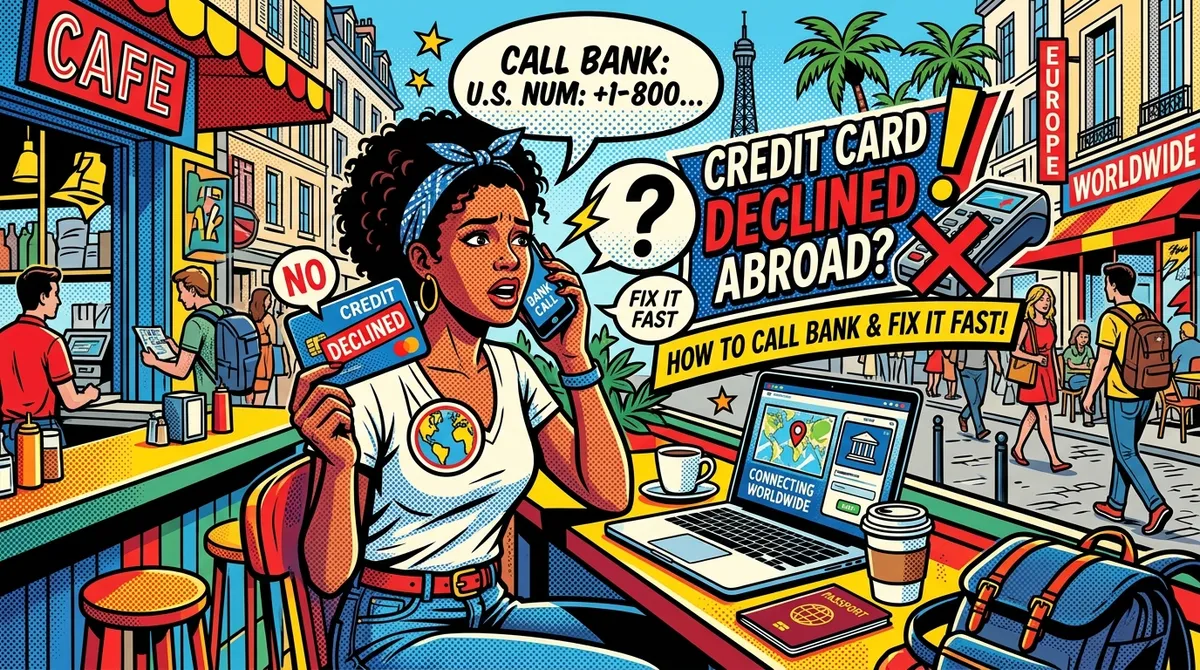
You’re checking out of a hotel in Lisbon. You hand over your Chase Visa. The front desk clerk swipes it, waits, and shakes her head. Declined.
You try again. Declined. You try your backup Amex. Also declined.
There’s a line forming behind you. Your Uber to the airport leaves in 40 minutes. And your bank’s fraud department just decided that your perfectly legitimate hotel bill looks suspicious.
This is one of the most common and stressful things that happens to people traveling internationally. Your credit card gets declined abroad, and you need to call your bank to fix it. Right now. Not tomorrow. Not when you get home. Now.
The problem? You’re in another country, your bank’s number is a US landline, and calling it on roaming will cost you more than the hotel bill.
Here’s how to handle it.
Why Your Credit Card Gets Declined Abroad
Before you panic, understand what’s happening. Banks use automated fraud detection systems that flag transactions based on patterns. When you suddenly start charging things in a foreign country, their system sees risk.
The Most Common Triggers
Unexpected location change. You were buying coffee in Brooklyn yesterday. Today you’re buying a hotel room in Portugal. The system flags it.
Large transactions. Hotels, rental cars, and flights are exactly the kind of big charges that trigger fraud alerts — and they’re also exactly what you need to pay for when traveling.
Multiple transactions in a short window. Airport taxi, hotel check-in, dinner, pharmacy. Four charges in three hours in a new country? That looks like a stolen card to an algorithm.
Chip-and-PIN vs. chip-and-signature. Some European terminals expect a PIN for credit transactions. If your US card doesn’t have a PIN set up for credit purchases, it can fail at the terminal level — not even a fraud block, just incompatibility.
Network issues. Sometimes the transaction just fails to process. The merchant’s terminal can’t reach your card network, or there’s a timeout. This isn’t a block from your bank — it’s infrastructure.
How to Tell the Difference
If your bank sent you a text or email about suspicious activity, that’s a fraud block. You need to call them.
If the transaction just silently failed with no notification, try the card at a different merchant first. It might be a terminal issue. If it fails again, call your bank.
Step-by-Step: Fixing a Declined Card From Abroad
Here’s the playbook. Follow it in order.
Step 1: Check Your Phone for Alerts
Most banks send a text or push notification when they block a card. Sometimes you can verify the transaction right from the text by replying “YES.” Check your messages before you call.
Chase, Bank of America, and Citi all offer text verification for suspected fraud. If you get the text, respond to it. Your card might be unblocked within 60 seconds without making a single phone call.
Step 2: Try Your Bank’s App
Open the Chase app, the BofA app, or whatever your bank’s mobile app is. Many banks now let you confirm transactions, temporarily unlock your card, or set travel notifications directly in the app. This is faster than calling.
Step 3: If You Need to Call — Find the Right Number
Toll-free US numbers (800, 888, 877, etc.) don’t work from abroad on most carriers. You need the bank’s international direct-dial number. These are regular US numbers with the +1 country code.
Here are the international contact numbers for major US banks and card issuers:
| Bank / Issuer | International Number | What to Say |
|---|---|---|
| Chase | +1-713-262-3300 | ”Fraud alert on my account, I’m traveling internationally” |
| Bank of America | +1-315-724-4022 | ”I need to remove a travel restriction on my card” |
| Wells Fargo | +1-925-825-7600 | ”My card was declined abroad, I need the fraud hold lifted” |
| Citi | +1-210-677-0065 | ”I’m calling about a blocked transaction while traveling” |
| American Express | +1-336-393-1111 | ”My card was declined internationally” |
| Capital One | +1-804-934-2001 | ”I need to verify a transaction flagged as fraud” |
| Discover | +1-801-902-3100 | ”Card declined while traveling, need the hold removed” |
| US Bank | +1-503-401-9991 | ”Fraud alert on my card, I’m overseas” |
Save these numbers in your phone before your next trip. Seriously, do it right now.
Step 4: Get Through the Phone Tree Fast
When you call, the automated system will try to route you. Here’s what works:
- Say “fraud” or “stolen card” — this usually gets you to a human faster than “account inquiry.”
- Have your card number, last four of your SSN, and your billing zip code ready.
- If asked “are you calling about a recent text alert,” say yes.
- Be specific: “I’m in Portugal, my card was declined at a hotel, I need the fraud hold lifted.”
Most banks can resolve this in 5-10 minutes once you reach a person. The problem is the 15-45 minutes of hold time before that.
Step 5: Confirm the Card Works
After the agent lifts the hold, ask them to stay on the line while you try the card again. If you’re at a merchant, run the transaction right there. If you’re not, ask the agent to confirm the hold is fully removed and when you can expect the card to work.
How to Call Your Bank Cheaply From Abroad
Here’s where the real cost problem hits. You need to call a US number, you’ll be on hold for at least 15-30 minutes, and the call itself could cost more than whatever you were trying to buy.
Let’s compare your options for a typical 30-minute call to a US bank number:
| Method | Cost (30-min call) | Pros | Cons |
|---|---|---|---|
| AT&T roaming | $60.00 - $90.00 | Works immediately | Brutally expensive |
| Verizon TravelPass | $10.00/day | Flat daily rate | You’re paying $10 even for a 5-min call |
| T-Mobile (Magenta) | $7.50 | Included roaming | Audio quality varies, especially in Asia |
| Skype (discontinued) | N/A | — | Shut down in May 2025 |
| Google Voice | Free | No cost | US residents only, quality issues abroad |
| YadaPhone | $0.60 | Very affordable | No SMS/2FA support |
| NomaPhone | $0.90 | Reliable, browser-based, no app needed | Needs internet connection |
| DialAnyone | $0.15 | Very low cost | — |
| Hotel phone | $15.00 - $45.00 | Always available | Hotels charge enormous markups |
| Calling card | $3.00 - $8.00 | Works without internet | Hidden fees, connection charges, hassle |
The math is pretty clear. Browser-based calling services cost under a dollar for the same call that costs $60-90 on carrier roaming.
The Hold Time Cost Problem
Here’s the thing nobody talks about. When your credit card gets declined abroad and you call your bank, the actual conversation to fix it takes maybe 5-10 minutes. But the hold time? That’s 15-45 minutes of waiting, listening to smooth jazz, and hearing “your call is important to us” on repeat.
With roaming, you’re paying for every second of that hold music.
| Scenario | Hold Time | Talk Time | Total | Roaming Cost (AT&T) | Browser VoIP Cost (NomaPhone) |
|---|---|---|---|---|---|
| Quick fix | 15 min | 5 min | 20 min | $50.00 | $0.60 |
| Average fix | 30 min | 10 min | 40 min | $100.00 | $1.20 |
| Transferred twice | 45 min | 15 min | 60 min | $150.00 | $1.80 |
That worst-case scenario — $150 in roaming charges to fix a problem your bank created — is not unusual. People pay it every day because they feel like they have no choice.
You have a choice.
Using Browser-Based Calling to Reach Your Bank
Browser-based calling works like this: you open a website in your phone’s browser (Chrome, Safari, whatever), enter the number, and call. It uses your internet connection — hotel WiFi, cafe WiFi, a local SIM’s data — instead of your carrier’s voice network.
No app to download. No account to create ahead of time. You can go from “my card is declined” to “I’m on hold with Chase” in about 30 seconds.
NomaPhone charges $0.03 per minute to call US numbers. That’s three cents. A 40-minute call to your bank — including all that hold time — costs $1.20.
Your credits never expire, there are no connection fees, and there are no monthly minimums. Buy $5 in credit and you’ve got over 160 minutes of US calling. That’s enough to deal with your bank, your insurance company, and your mom asking when you’re coming home.
Is NomaPhone the absolute cheapest VoIP option? No. DialAnyone charges $0.005 per minute. YadaPhone charges $0.02 per minute. But when your card is frozen and you’re standing in a hotel lobby with a line behind you, you want something that connects reliably to your bank’s phone system without dropping. Three cents a minute for a call that actually works is a reasonable trade.
Prevention: Stop Your Card From Getting Declined in the First Place
You can avoid most of this stress with 10 minutes of prep before your trip.
Set a Travel Notice
Most banks let you set travel notifications in their app. Tell the bank where you’re going and when. Chase, BofA, Citi, and Capital One all support this in their mobile apps.
Note: some banks (including Chase as of 2024) have stopped requiring travel notices and claim their systems are smart enough to know you’re traveling. In practice, cards still get declined. Set the notice anyway. It takes 30 seconds.
Carry Two Cards From Different Networks
Visa and Mastercard have different fraud algorithms. If your Visa gets blocked, your Mastercard might still work. Carry at least two cards from different banks on different networks.
Set Up a PIN for Credit Purchases
Some European and Asian terminals require a PIN even for credit cards. Call your bank before you leave and ask for a credit card PIN. Not a cash advance PIN — a transaction PIN.
Enable Push Notifications
Make sure your bank’s app can send you push notifications. The faster you see a fraud alert, the faster you can respond to it — ideally by text, without needing to call at all.
Keep Your Bank’s International Number Saved
Don’t wait until you’re panicking in a hotel lobby to Google “Chase international phone number.” Save the number now. Refer to the table above.
Have a Local Payment Backup
In many countries, you can pay with local apps or cash. Keep some local currency on hand. In Europe, a Wise debit card (linked to a multi-currency account) is a solid backup that rarely gets flagged.
Quick Reference: Card Declined Abroad Checklist
Use this when it happens:
- Check your phone for a fraud alert text — reply to verify if possible
- Try your bank’s app to confirm the transaction or unlock the card
- Try a different card at the same merchant
- If nothing works, call your bank’s international number (see table above)
- Use browser-based calling or WiFi calling to avoid roaming charges
- Have your card number, SSN last four, and zip code ready
- Say “fraud” to get through the phone tree faster
- Ask the agent to confirm the hold is lifted before hanging up
- Test the card again before leaving the merchant
It Happens to Everyone
Having your credit card declined abroad is not a sign that you did something wrong. It’s an annoying side effect of fraud protection systems that weren’t designed for people who move between countries regularly.
The fix is almost always a phone call. The key is making that phone call without spending $50-150 on roaming charges while you wait on hold.
Save your bank’s international numbers. Have a backup card. And have a way to make cheap calls to the US from anywhere — whether that’s NomaPhone or another browser-based service.
Because the next time your card gets declined at a hotel checkout counter, the last thing you want to worry about is how much the phone call to fix it is going to cost.
NomaPhone lets you call US bank numbers from any browser, anywhere in the world, for $0.03/min. No app download. No contracts. Credits never expire. Next time your card gets frozen abroad, just open your browser and call. Try NomaPhone