How to Call Canada From Abroad (It's Not Always Free)
Need to call Canada from abroad? Country code +1 tricks people into thinking it's free. Compare real costs, methods, and why Google Voice won't help.
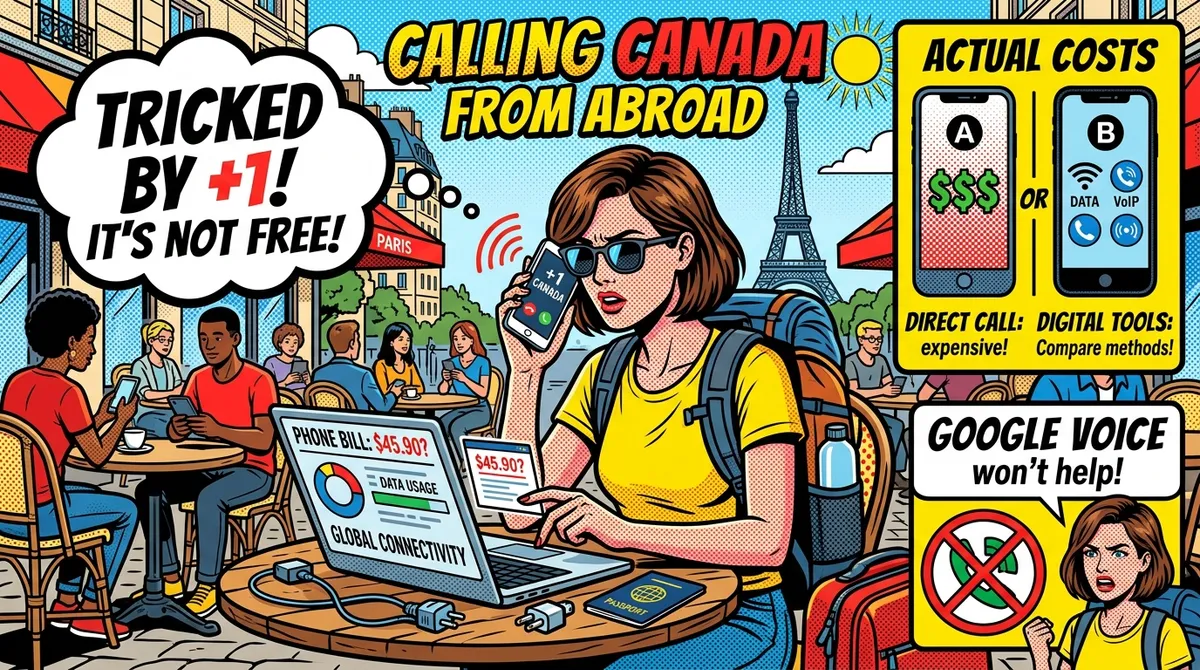
You’re sitting in a cafe in Lisbon and you need to call your Canadian bank. You dial the number like you would from the US — area code, seven digits — and nothing happens. Or worse, it connects and your carrier charges you $2.50 per minute because you forgot you’re not in North America anymore.
Here’s the thing most people don’t realize: Canada and the United States share the same country code (+1). That makes people assume calling Canada from abroad works the same as calling the US. Sometimes it does. Often it doesn’t. And “free” tools like Google Voice? They stop working the moment you leave American soil.
This guide breaks down every method to call Canada from abroad, with real costs, real limitations, and honest comparisons.
Why Calling Canada Confuses People
Canada is part of the North American Numbering Plan (NANP). That means Canadian phone numbers look identical to American ones. A Toronto number (416-555-1234) has the same format as a New York number (212-555-1234). Both use country code +1.
This creates three common misconceptions:
“If I can call the US for free, I can call Canada for free.” Not necessarily. Some VoIP services and carrier plans treat Canada as a separate international destination. Others bundle it with the US. You have to check the fine print.
“I don’t need the country code for Canada.” From abroad, you absolutely do. You need to dial +1 followed by the area code and number. Skip the +1 and your call goes nowhere.
“My Google Voice account will handle it.” Google Voice works beautifully for calling Canada — if you’re physically in the United States. Step outside the US border and Google Voice becomes unreliable or stops working entirely. More on that below.
The Country Code +1 Explained
Canada and the US both use +1 as their country code. When you’re calling Canada from abroad, you dial:
+1 + area code + 7-digit number
So calling a Vancouver number looks like: +1 604 555 1234
Calling a Montreal number looks like: +1 514 555 1234
The + symbol tells your phone to use the international dialing prefix for whatever country you’re currently in. In most countries, that prefix is 00. So from a German landline, you’d dial 00 1 604 555 1234.
From a mobile phone anywhere in the world, just use the + sign. Every phone supports it.
Common Canadian Area Codes
Knowing these helps you recognize Canadian numbers and avoid confusion with US numbers:
| Province/City | Area Codes |
|---|---|
| Toronto, Ontario | 416, 647, 437 |
| Vancouver, British Columbia | 604, 778, 236 |
| Montreal, Quebec | 514, 438 |
| Calgary, Alberta | 403, 587 |
| Ottawa, Ontario | 613, 343 |
| Edmonton, Alberta | 780, 587 |
| Winnipeg, Manitoba | 204, 431 |
| Halifax, Nova Scotia | 902, 782 |
There’s no trick to distinguishing a Canadian area code from an American one by sight. Both countries pull from the same pool. If someone gives you a number starting with 416, the only way to know it’s Toronto (not a US city) is context.
Why Google Voice Won’t Save You Abroad
Google Voice is the go-to for Americans who want free calls to Canada and the US. And it’s genuinely great — when you’re in the US.
The problem: Google Voice is designed for US residents, used from US soil. Here’s what happens when you try to use it abroad:
Calls may not connect. Google Voice uses your IP address to determine location. From some countries, outbound calls simply fail.
Quality degrades. Even when calls do connect from overseas, users report significant lag, echo, and dropped audio — especially from Asia and Africa.
SMS and 2FA stop working. If you’re relying on Google Voice for verification codes from Canadian banks or services, expect delays or missing messages when you’re abroad.
Account restrictions. Google has been known to flag accounts that consistently make calls from non-US IP addresses. Some users report temporary suspensions.
No phone support. If something breaks, there’s no customer service number to call. It’s a free product, and the support reflects that.
Google Voice works for Americans calling Canada from their couch in Ohio. It’s not a reliable tool for calling Canada from a coworking space in Bangkok.
Every Method to Call Canada From Abroad
Here’s a straightforward comparison of every realistic option. All costs assume calling a Canadian landline or mobile number from outside North America.
Method 1: Carrier Roaming
Your existing phone plan, used internationally. You dial like normal and your carrier handles the routing.
Cost: $1.00 to $3.00 per minute, depending on your carrier and where you are.
- AT&T International Day Pass: $10/day for unlimited calls (including to Canada)
- T-Mobile Magenta: $0.25/min from 200+ countries
- Verizon TravelPass: $10/day
- Canadian carriers (Rogers, Bell, Telus): $6-12/day roaming passes, or $1.50-2.00/min without a pass
Pros: No setup required. Works immediately. Uses your real number.
Cons: Expensive without a day pass. Day passes add up fast on longer trips. Call quality depends on local carrier agreements.
Method 2: WhatsApp / FaceTime Audio
Free internet-based calls — but only if the person you’re calling also uses the same app.
Cost: Free (uses your data/Wi-Fi).
Pros: No per-minute charges. Good audio quality on stable connections.
Cons: Both parties need the app. Doesn’t work for calling businesses, banks, government offices, or landlines. Your Canadian bank’s customer service line isn’t on WhatsApp.
Method 3: Google Voice
Free calls to Canada from the US. Unreliable from abroad.
Cost: Free (from the US). May not work internationally.
Pros: Free when it works. Familiar interface.
Cons: US-only by design. Unreliable audio from abroad. No support. Can’t call Canadian toll-free numbers from outside the US.
Method 4: Calling Cards
Prepaid cards with access numbers. Old-school but still available.
Cost: $0.01 to $0.10 per minute (advertised), but hidden fees push real costs to $0.15-0.30/min.
Pros: Works from any phone, including landlines. No internet required.
Cons: Connection fees ($0.50-1.00 per call). Maintenance fees that drain your balance. Terrible audio quality. Clunky dialing process. Many brands have disappeared in recent years.
Method 5: Skype (Now Discontinued)
Skype was once the default for international calling. Microsoft shut it down in May 2025. If you’re still searching for “Skype to call Canada,” it’s time for a new plan.
Method 6: Browser-Based VoIP
Services like NomaPhone, YadaPhone, and DialAnyone let you call Canadian numbers directly from your web browser. No app download, no SIM card, no country restrictions.
Cost: $0.005 to $0.03 per minute, depending on the service.
Pros: Works from anywhere with internet. No app installation. Pay only for what you use. Call any Canadian number — landlines, mobiles, businesses, banks.
Cons: Requires a stable internet connection. Audio quality depends on your connection speed.
Cost Comparison: 30-Minute Call to Canada
Let’s make this concrete. You need to call a Canadian number for 30 minutes — maybe it’s your bank, maybe it’s a family member on a landline, maybe it’s a business you’re dealing with.
| Method | Cost (30-min call) | Works From Abroad? | Call Any Number? |
|---|---|---|---|
| AT&T roaming (no pass) | $60.00 - $90.00 | Yes | Yes |
| AT&T International Day Pass | $10.00 | Yes | Yes |
| T-Mobile Magenta roaming | $7.50 | Yes | Yes |
| Verizon TravelPass | $10.00 | Yes | Yes |
| Google Voice | Free | Unreliable | Yes (from US) |
| WhatsApp/FaceTime | Free | Yes | No (app-to-app only) |
| Calling card (real cost) | $4.50 - $9.00 | Yes | Yes |
| DialAnyone | $0.15 | Yes | Yes |
| YadaPhone | $0.60 | Yes | Yes |
| NomaPhone | $0.90 | Yes | Yes |
The difference is stark. Carrier roaming without a plan can cost 100 times more than browser-based VoIP for the same call.
US vs. Canada Calling: What’s Actually Different?
People treat “US and Canada” as one destination. In many cases, they are. But there are meaningful differences when calling from abroad.
Where They’re the Same
- Same country code (+1)
- Same number format (10 digits: area code + 7 digits)
- Most VoIP services charge the same rate for both (NomaPhone charges $0.03/min for both US and Canada)
- Most carrier roaming plans treat them identically
Where They Differ
Toll-free numbers. Canadian toll-free numbers (1-800, 1-833, 1-855, 1-866, 1-877, 1-888) only work from within Canada or the US. If you’re calling a Canadian company’s 1-800 number from Europe, it probably won’t connect. You’ll need their direct number instead.
Local rate numbers. Some Canadian businesses use numbers that are local-rate within Canada but international-rate from abroad. This is especially common with government services.
Banking verification. Canadian banks (RBC, TD, Scotiabank, BMO, CIBC) often use SMS verification tied to Canadian phone numbers. If you’ve ported your number or are using a foreign SIM, these verifications can fail. This is one of the biggest headaches for Canadian expats.
French-language IVR. Call a government office in Quebec and you’ll navigate a French-language phone tree before reaching English options. Not a cost issue, but something to prepare for if you’re calling Service Canada or Revenue Quebec from abroad.
Area code overlap confusion. Since US and Canadian area codes come from the same numbering plan, you might accidentally call a US number thinking it’s Canadian, or vice versa. Always confirm the full number with whoever you’re trying to reach.
Calling Canadian Banks From Abroad
This deserves its own section because it’s one of the most common reasons people search for how to call Canada from abroad.
Canadian banks are notoriously phone-centric. Many things that US banks let you do online, Canadian banks require a phone call for. Fraud disputes, credit limit changes, mortgage discussions — they want you on the phone.
Here are the direct (non-toll-free) numbers for major Canadian banks:
| Bank | Direct Number (from abroad) |
|---|---|
| RBC Royal Bank | +1 416 974 7780 |
| TD Canada Trust | +1 416 982 7250 |
| Scotiabank | +1 416 701 7200 |
| BMO Bank of Montreal | +1 514 877 1101 |
| CIBC | +1 416 980 3300 |
These are the numbers that work when you’re dialing from outside Canada. The 1-800 numbers on their websites won’t connect from most international locations.
Pro tip: Call during Eastern Time business hours. Canadian bank hold times are shortest between 8-9 AM ET on weekdays. At 3 cents per minute with a service like NomaPhone, even a 45-minute hold only costs $1.35.
Calling Canadian Government Services From Abroad
If you’re a Canadian citizen living abroad, you’ll occasionally need to reach government offices. These calls are rarely quick.
Service Canada (general): +1 613 990 2244 (from outside Canada)
CRA (Canada Revenue Agency): +1 613 940 8496 (individual tax inquiries from abroad)
Passport Canada: +1 819 997 8338
IRCC (Immigration): +1 613 321 4063
Government hold times can be brutal. Budget for 30-60 minutes minimum. At carrier roaming rates, that’s $30-180. At $0.03/min with browser-based VoIP, the same call costs $0.90 to $1.80.
How to Get the Best Audio Quality
Calling Canada from abroad over the internet is only as good as your connection. Here’s how to make sure your calls sound clean:
Use Wi-Fi, not mobile data. Wi-Fi is more stable for voice calls. Coffee shop Wi-Fi works, but a coworking space or hotel room is better.
Close unnecessary tabs and apps. Video streaming in the background eats bandwidth that your call needs. Close YouTube, pause downloads, and give your call priority.
Use headphones with a built-in mic. Your laptop microphone picks up ambient noise. Even basic earbuds with a mic will sound dramatically better.
Test your connection first. If your internet speed is under 1 Mbps upload, expect audio issues. Most speed test websites can confirm this in seconds.
Have a backup plan. If Wi-Fi drops mid-call, know what you’ll do. Can you switch to mobile data? Is there a stronger connection nearby?
When VoIP Isn’t the Right Choice
Browser-based calling works for most situations. But there are times when other methods make more sense:
Emergency calls. VoIP cannot reliably reach 911 in Canada (or 112 in Europe). For emergencies, use a local SIM or landline.
Areas with no internet. If you’re in a rural area with spotty Wi-Fi and no mobile data, a calling card or local SIM with an international plan is your only option.
Extremely sensitive calls. If you’re dealing with a legal matter where call quality absolutely cannot falter, consider a local SIM with a Canada-specific plan, or call from a business center with a wired connection.
Quick Reference: Calling Canada From Popular Nomad Destinations
| Your Location | Cheapest Reliable Method | Notes |
|---|---|---|
| Mexico | Browser VoIP ($0.03/min) | Strong Wi-Fi widely available. Cell roaming from US carriers often includes Canada. |
| UK/Europe | Browser VoIP ($0.03/min) | Excellent internet infrastructure. Time zone overlap with Eastern Canada. |
| Thailand | Browser VoIP ($0.03/min) | Good Wi-Fi in cities. 12-hour time difference to Eastern Canada — plan calls carefully. |
| Portugal | Browser VoIP ($0.03/min) | Nomad-friendly internet. 4-5 hour difference to Eastern Canada. |
| Colombia | Browser VoIP ($0.03/min) | Improving internet. Same time zone as Eastern Canada in some cities. |
| Bali, Indonesia | Browser VoIP ($0.03/min) | Wi-Fi quality varies. 13-hour difference to Eastern Canada. |
| Japan | Browser VoIP ($0.03/min) | Excellent internet. 14-hour difference makes timing tricky. |
The method stays the same. The real variable is your time zone gap and local internet quality.
Frequently Asked Questions
Is calling Canada the same as calling the US from abroad?
In terms of dialing format and country code, yes. Both use +1. Most VoIP services and many carrier plans charge the same rate for both. The differences are in toll-free number accessibility and banking verification systems.
Can I call Canadian toll-free numbers from outside Canada?
Usually not. Most Canadian 1-800/1-888 numbers are restricted to calls originating from within Canada or the US. You’ll need the company’s direct local number instead. Check their website’s “contact us” page for an international number.
Why does Google Voice not work when I travel?
Google Voice is built for US-based users. It uses your IP address and account history to determine if you’re in the US. From abroad, calls may fail, have poor quality, or trigger account restrictions. Google doesn’t officially support international use of Voice for outbound calling.
Do I need a Canadian phone number to call Canada?
No. You can call any Canadian number from any country using the international format (+1 + area code + number). You don’t need a Canadian SIM or Canadian phone number to reach someone in Canada.
What’s the cheapest way to call Canada from abroad?
DialAnyone offers the lowest per-minute rate at $0.005/min. YadaPhone charges $0.02/min. NomaPhone charges $0.03/min. All three are browser-based and work from anywhere. NomaPhone isn’t the cheapest option, but it focuses on call quality and reliability — three cents per minute for a call that actually connects when you need it to.
NomaPhone lets you call Canada from your browser at $0.03 per minute. No app to download, no SIM card to swap, no contracts. Just open your browser, enter the Canadian number, and you’re connected in about 30 seconds. Your credits never expire, and you only pay for the minutes you use. Whether you’re calling RBC about a frozen card or catching up with family in Vancouver, it just works — from anywhere in the world.